
The Flexible Display Center at Arizona State University has promised that thin paper-like displays are just about three years away from field trials.
Using a a production method called Self-Aligned Imprint Lithography (SAIL), these displays can be mass manufactured in the form of rolls instead of sheets, which manages to make the production method more cost effective.
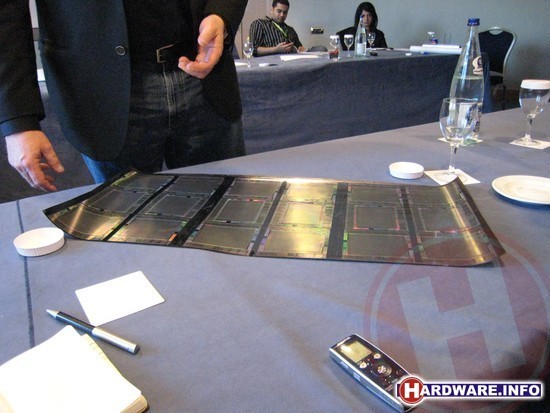
Interestingly, HP doesn’t acutally see these panels being used in truly flexible or rollable displays the material itself would only survive being rolled up about a half dozen times but instead sees them mostly being used to make displays thinner and lighter.
Using a a production method called Self-Aligned Imprint Lithography (SAIL), these displays can be mass manufactured in the form of rolls instead of sheets, which manages to make the production method more cost effective.
The displays are flexible enough to be “rolled, folded like a newspaper, or bent to fit around a building or car”, not only that they are more environment friendly, as these displays use 90% less material than the displays today. As Carl Taussig, director, Information Surfaces, HP Labs says, “In addition to providing a lower-cost process, SAIL technology represents a more sustainable, environmentally sensitive approach to producing electronic displays.”
“We want to lower the costs of traditional flat panel displays and increase their functionality,” says Carl Taussig, director of information surfaces for HP Labs.
Flexible displays are paper-like computer displays made almost entirely of plastic. They are easily portable and consume lower power than current displays.
Taussig says HP has been able to create a manufacturing process for the prototype that would allow the fabrication of thin film transistor arrays on flexible plastic materials. The displays would be created using roll-to-roll manufacturing, much like how a newspaper is printed in the press. That compares to a batch production that traditional displays use, similar to the process of cutting individual cookies.
“Roll-to-roll is about reducing costs ultimately,” says Taussig.
The prototype display is black and white but Taussig says the process can be used to create flexible color displays. HP has licensed the technology to PowerFilm Solar, a company that specializes in flexible solar panels.
Though HP doesn’t as yet have an estimate of what a flexible display will eventually cost consumers, the company says it expects the first displays to be available to the U.S. Army for trials in the next three years.

Pingback: uberVU - social comments
I have to do Chapter Presentation n a wk; please send some samples or steps how to make this Power Pre .. d bez to U & Crew. time frame is about 15 minutes
Pingback: Direct Marketing for Small Business | Best Franchise Advice
Pingback: Hotels connecting dots to online reviewers | Web Traffic Siphon