
One of the most difficult problems for designing mobile devices is finding a way to minimize the size of the device while simultaneously maximizing the size of the display and Sammy’s Advanced Institute of Technology now has built a prototype of a seamless foldable display that folds in half without a visible crease in the middle………….
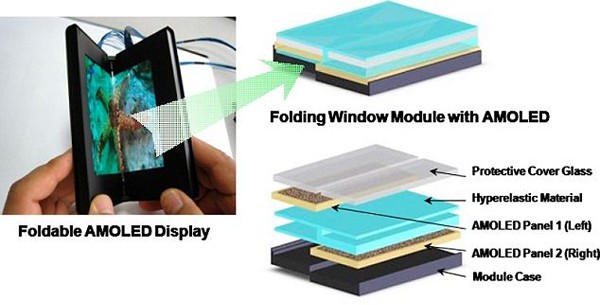
Mobile phone manufacturers have unsuccessfully tried to make smaller devices with bigger screen displays, Samsung has succeeded in creating foldable AMOLED displays and also showed mankind that the future belongs to non-rigid screens.Now get ready for better AMOLED aka Active Matrix Organic Light Emitting Diodes. Samsung Advance Institute Of Technology in South Korea designed & created the first prototype that easily folds in the middle and show no crease even after 1000 attempts. The consumer electronic industry is rapidly advancing towards smaller & flexible devices and there has been a great interest in the development of flexible displays. Researchers have already succeeded in developing displays which can be rolled and bent. Such screen provide the portability factor to large screens. However the biggest problem associated with the flexible displays is the development of crease in the middle. Samsung’s new technology eliminates that problem to a great extent.Samsung’s AMOLED display consists of two panels, silicone rubber (very elastic in nature), glass cover for protection and a module case. The panel has a tiny folding radius of 1 mm which makes the two panels completely lay over each other when folded in 180°. The glass cover serves the dual purpose of touch screen and preventing the scratches. The testing results of these displays have been astonishing. Scientists performed about 100k rapid, continuous folding and unfolding operation on these displays but there was no sign of crease. After the completion of cycles, the brightness at the junction showed reduction in brightness only by 6%. The difference between the brightness at the junction and the rest of the screen is barely noticeable to human eyes and the display looks uniform.Samsung’s researcher said that the displays can soon be commercially produced. The elastic silicone rubber is commercially available for mass consumption by manufacturers. Researchers are now focusing on development of larger foldable displays.
[ttjad keyword=”electronic”]
well they are going about it the wrong way, the key to this problem is the shape and how the purpose are organize at the bending point of the display, the purpose have to be in a marble like shape, they must be i the
arrangement of 3 straight rows with one in the middle and one row on
each sides of the folded half.