Google announced that it is finally waving goodbye to its much-hyped but rarely understood and often-maligned Google Wave project. Google Wave was an email application with real-time communication and collaboration facilities added on.
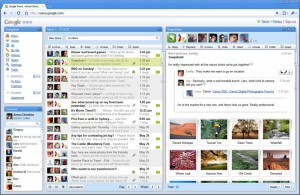
Wave was composed of several technically innovative individual parts, like its real-time, as-you-type chat, an advanced spellcheck algorithm and the ability for developers to build their own add-ons. Innovative enough, in fact, to receive a Best of What’s New nod last year. But the service lacked cohesion. Put simply: no one knew what to use it for.
Most users found it too complex and in many ways ill-suited to the task. Having co-workers see what you’re typing each keypress at a time–mistakes, recasts, backspaces and all–was more awkward than useful. And I still don’t think I understand the methodology of storing conversations and projects in “Waves.”
We, apparently, weren’t alone. Google says “Wave has not seen the user adoption we would have liked.” It will be maintained through the end of the year, and for those rarefied few that understood the service enough to start using it, they’ll have a way to export all their data before the plug is pulled for good.
There will be plenty of coverage today reeling off lists of Google’s failures; Google Squared, Google Answers, Google Radio, Google Lively, Google Health, Google Notebook and Dodgeball among them. Those will be reliably dwarfed by Google’s successes. Our European perspective might make us more critical of failure than in the US, where it is more rightly regarded as an inevitable and positive sign of productivity and innovation.
Chief executive Eric Schmidt himself said of the Wave failure that it is just a symptom of trying things out. “Remember, we celebrate our failures. This is a company where it’s absolutely OK to try something that’s very hard, have it not be successful, and take the learning from that,” he told journalists late yesterday.
Co-founder Sergey Brin was convinced to support the Wave concept by a Google development team in Australia. “When they came and proposed this idea they said, ‘We want to do something new and revolutionary, but we’re not even going to tell you what it is. And we want to go back to Australia, hire a bunch of people and just work on it.’ ,” Brin told the Guardian shortly after Wave’s launch. “That was a crazy proposal. But, having seen their success with Maps, I felt that it actually was pretty reasonable.”
When Wave launched at I/O, some developers were waving their laptops in the air. It was a moment.
I’d file this under ideas that were just a little ahead of their time. With refinement, a clearer proposition and better integration with existing services, it would have stood a better chance. Wave was one stab at tackling our information overload, at providing a central hub for all the information we need to deal with every day. And it will be back, in one form or another.
Source: Popular Science, Guardian.