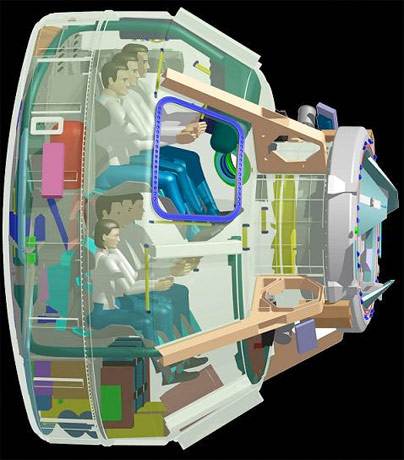
Boeing’s CST-100 spiffy capsule that can hurtle a lucky seven humans 100km into the dark abyss and the crew will follow two unmanned missions, eventually reaching the International Space Station. Boeing says two of its own employees will crew the first manned mission of its new astronaut capsule and confirmed it will use the Atlas 5 rocket to test its CST-100 ship on three flights in 2015……………
The Boeing Company announced it has selected the United Launch Alliance (ULA) Atlas V rocket to launch the Boeing Crew Space Transportation (CST)-100 spacecraft from Florida’s Space Coast. “This selection marks a major step forward in Boeing’s efforts to provide NASA with a proven launch capability as part of our complete commercial crew transportation service,” said John Elbon, vice president and program manager of Commercial Crew Programs and the source selection official for Boeing. If NASA selects Boeing for a development contract with sufficient funding, ULA will provide launch services for an autonomous orbital flight, a transonic autonomous abort test launch, and a crewed launch, all in 2015. The addition of ULA to the Boeing team enables the start of detailed design work on an integrated system for launch and spacecraft operations. The team also will refine launch abort operations that will meet NASA‘s stringent human rating requirements to safely transport crew and cargo to the International Space Station. Boeing conducted a best-value competition among U.S. launch service providers prior to selecting the Atlas V.
“We are pleased Boeing selected the Atlas V rocket and believe it is the right vehicle to help usher in the new commercial era in human spaceflight,” said George Sowers, ULA vice president of Business Development. “The Atlas V is a cost-effective, reliable vehicle and ULA stands ready to support Boeing’s commercial human spaceflight program.” Boeing plans to begin wind tunnel testing of the Atlas V and the CST-100 this year and will use the results to complete a preliminary design review of the integrated system in 2012 under the second round of its Commercial Crew Development Space Act Agreement with NASA. The Commercial Crew program consists of developing, manufacturing, testing and evaluating, and demonstrating the CST-100 spacecraft, launch vehicle and ground/mission operations – all part of Boeing’s Commercial Crew Transportation System for NASA‘s new Commercial Crew human spaceflight program that will provide access to the International Space Station. The CST-100 is a reusable, capsule-shaped spacecraft that includes a crew module and a service module. It relies on proven, affordable materials and subsystem technologies that can transport up to seven people, or a combination of people and cargo. A unit of The Boeing Company, Boeing Defense, Space & Security is one of the world’s largest defense, space and security businesses specializing in innovative and capabilities-driven customer solutions, and the world’s largest and most versatile manufacturer of military aircraft. Headquartered in St. Louis, Boeing Defense, Space & Security is a $32 billion business with 64,000 employees worldwide.
[ttjad keyword=”general”]