
Researchers in France have found a way to double the storage capacity of magnetic disk drives by constructing 3D towers of information, the team from SPINTEC created these pillars out of bit-patterned media separated magnetic nanodots and each of which carries one bit of data.By layering the dots in specific formations, the team created a multilevel magnetic recording device with an areal density of two bits per dot…………
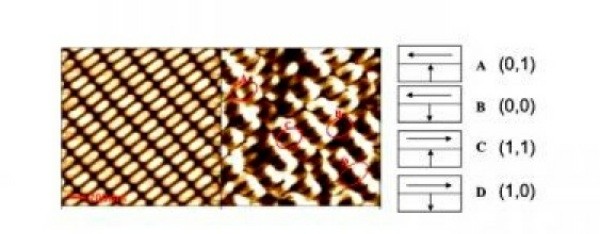
Using well-known patterned media, a team of researchers in France has figured out a way to double the areal density of information by essentially cutting the magnetic media into small pieces and building a 3D tower out of it.This greatly enhances the amount of data that can be stored in a magnetic storage device and provides a method to reach beyond a wall of physical limits that the currently used technology is hitting. The team presents their findings in the American Institute of Physics’ Journal of Applied Physics.“Over the past 50 years, with the rise of multimedia devices, the worldwide Internet, and the general growth in demand for greater data storage capacity, the areal density of information in magnetic hard disk drives has exponentially increased by 7 orders of magnitude,” says Jerome Moritz, a researcher at SPINTEC, in Grenoble. “This areal density is now about 500Gbit/in2, and the technology presently used involves writing the information on a granular magnetic material. This technology is now reaching some physical limits because the grains are becoming so small that their magnetization becomes unstable and the information written on them is gradually lost.”
Therefore, new approaches are needed for magnetic data storage densities exceeding 1Tbit/in2.“Our new approach involves using bit-patterned media, which are made of arrays of physically separated magnetic nanodots, with each nanodot carrying one bit of information. To further extend the storage density, it’s possible to increase the number of bits per dots by stacking several magnetic layers to obtain a multilevel magnetic recording device,” explains Moritz.In that context, Moritz and colleagues were able to demonstrate that the best way to achieve a 2-bit-per-dot media involves stacking in-plane and perpendicular-to-plane magnetic media atop each dot. The perpendicularly magnetized layer can be read right above the dot, whereas the in-plane magnetized layer can be read between dots. This enables doubling of the areal density for a given dot size by taking better advantage of the whole patterned media area.
[ttjad keyword=”general”]