Saturday saw Chile shaken by a powerful magnitude 8.8 earthquake that turned thousands of buildings to rubble and killed hundreds of people. However, Discovery.com is reporting that Chile’s hsve remained pretty much unharmed during the quake, with a few servers losing power for a while.
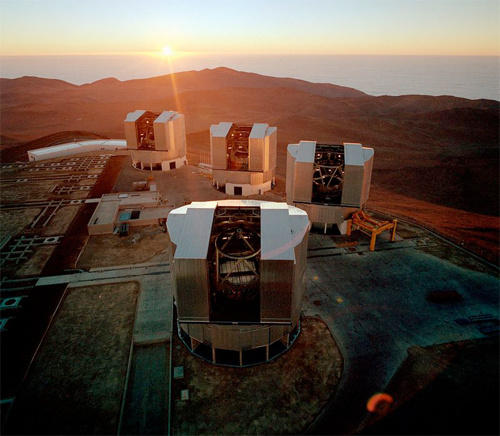
Pictured is the European Southern Observatory’s VLT which was built on a 2,635 meter high mountain in the Atacama desert of Chile, which is 50 times drier than Death Valley in California. It’s also 1,370km north of the earthquake’s epicenter, with the Gemini South Observatory just 800km away from the epicenter on the Cerro Pachón mountain. Its servers went offline for a while after the quake, but have been restored—with other telescopes in the area faring just as well, with just power cuts reported so far.
As the country has a long history of earthquakes, the VLT and Gemini South telescopes fared well. Author Anil Ananthaswamy, an expert on such situations, said both telescopes have been built to withstand natural disasters such as Saturday’s 8.8 shocker.
Discovery News reports:
The primary mirror is 18 centimeters thick. Because of its weight, the mirror’s precise shape can warp when it is tilted, so 150 actuators, upon which the mirror rests, continually push and pull at least once a minute to ensure that the optimal curvature is maintained. More impressive than the actuators are the clamps around the edges of the mirror, which can, at a moment’s notice, lift the entire mirror, all 23 tons of it, off the actuators and secure it to the telescope’s support structure in case of an earthquake (moderate quakes, of less than 7.75 Richter, are not uncommon here, thanks to the ongoing collision of the Nazca and South American plates). The entire telescope is designed to swing during an earthquake, and securing the primary mirror prevents it from rattling against the metal tubes that surround it.