
I think you already have guessed from the headline what I want to say. It’s the scenario of the behind the screen of the IT department of the Vancouver Winter Olympics 2010. This winter Olympics has brought some headache for the organizing committee. But no one knows what they are doing behind to give you all the updates and make this event successful. To do that “6,000 PCs, 800 servers, 800 networking devices and 130 terabytes of data” are driving the Vancouver Olympics.
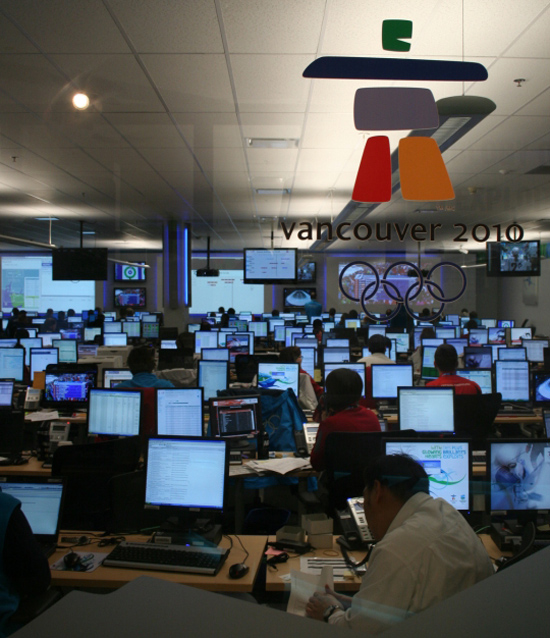
The office is a low-rise building in east Vancouver from where the technology operations are headquartered. CNET’s Ina Fried caught up with Atos Origin’s Magnus Alvarsson, one of the folks responsible for setting up the HQ’s IT.
“In here, our objective is to be bored,” said Atos Origin’s Magnus Alvarsson, one of those in charge of overseeing the Olympics’ IT setup. And from where he sits, just outside the computer-filled room that is the equivalent of NASA’s mission control, things have been just about as uneventful as he could hope for.
Among the biggest problems have been minor things such as people forgetting their password or moving computers from one location to another at a venue. “It shows up on our monitoring that someone is unplugging something,” Alvarsson said.
His team also had to move some wiring at the luge site when the course was rerouted after the death of a Georgian athlete.
“They moved the start point a little,” he said. “We had to re do a little bit of cabling.”
Although the Games are still just a few days old and workers continue to monitor things, Alvarsson said his thoughts are starting to turn to the process of taking out the massive amounts of computing and networking gear installed at spots throughout Vancouver and Whistler.
“We know that the solution we put in place works,” he said. “Now it has to be something very unforeseen like an outside agent or a power outage for there to be a technology issue.”
Sure there have been controversies over cauldrons, weather woes, and snow-lacking slopes, but Alvarsson said, “I’m very happy to say we have nothing to do with the hydraulics. We only deal with the information technology.”