
Canadian scientists have created a pair of dancing, crying robots using parts from Nokia’s N82 cell phones. The robots, named Callo and Cally, have limbs and can dance, cry, throw tantrums and communicate with each other. Cally stands about 7 inches high and walks, dances and mimics human behavior. Callo stands about 9 inches tall, and his face, which is a cell phone display screen, shows human facial expressions when he receives text-messaged emotions. When he receives a smile emoticon, Callo stands on one leg, waves his arms and smiles.
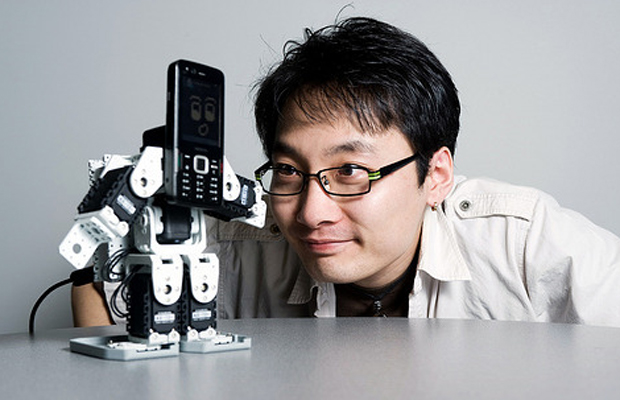
If he receives a frown, his shoulders slump and he will cry. If he gets an urgent message, or a really sad one, he’ll wave his arms frantically. Ji-Dong Yim, a PhD student in interactive arts and technology at Simon Fraser University in Vancouver, says it’s basically a simple avatar system. The robots can communicate with each other, for instance when their masters are on a video call.
“When you move your robot, my robot will move the same, and vice versa, so that we can share emotional feelings using ‘physically smart’ robot phones,” he says in an SFU release.
The robots, which are made from Nokia N82 phone parts and components from a Bioloid robot kit, can detect human faces using OpenCV software. Cally can even track users’ facial expressions during a phone call.
The robots can also be preprogrammed to move in certain ways when receiving calls from specific phone numbers.
Yim, a software developer for a small company, completed his master’s degree in product design. He says he hopes that Callo’s technology can be sold for everyday use, but right now he’s too busy finishing up his PhD to focus on marketing his product.
Shaw, an associate professor at SFU’s School of Interactive Arts and Technology, said the two are developing a wide range of human-robot cellphone service scenarios and prototypes of Cally, Callo and other robot cellphones.
Shaw said the robot cellphone is a new category of electronic product that is fun and functional and that serves as both a toy and a work buddy.
“We’re using them to explore ways in which we can help social robotic products, such as GPS, interactively communicate with people and build long-term intimacy with them,” Shaw said.
Source: Vancouver Sun.


Pingback: http://%/bvxhuet
I have got 1 recommendation for your web site. It looks like right now
there are a few cascading stylesheet troubles while opening a selection
of webpages within google chrome as well as opera. It is operating
alright in internet explorer. Probably you can double check this.