
Swiss scientists are preparing an $11 million satellite called ‘CleanSpace One’. It is being built by the Swiss Space Center at the Swiss Federal Institute for Technology (EPFL) in Lausanne. The purpose of this ‘Janitor Satellite’ is to clean up space. Its target is to derelict satellites 430 miles up that threaten our communications and information networks. It’s specially designed to tackle the 17,000 mph (approximately 27359 kmph) mess around our planet created by human beings.
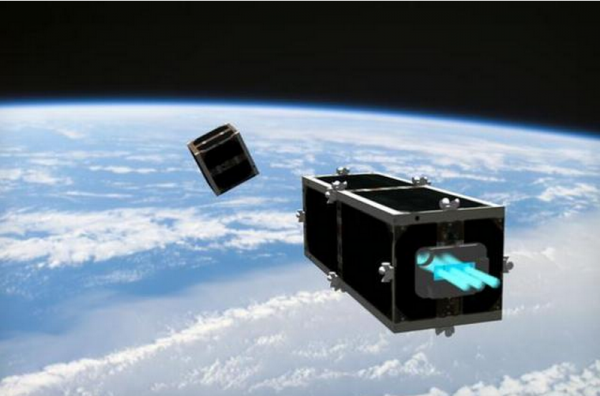
Swiss scientists said on Wednesday they are planning to launch a ‘Janitor Satellite’ which is been specially designed to get rid of space junk (we call them debris). This orbiting debris is able to do serious and costly damage to valuable satellites and space ships. The ‘Janitor Satellite’ will fly through space. It will chase down space debris and then drag them to Earth’s atmosphere to burn up on re-entry and thus it will make the skies a little safer.
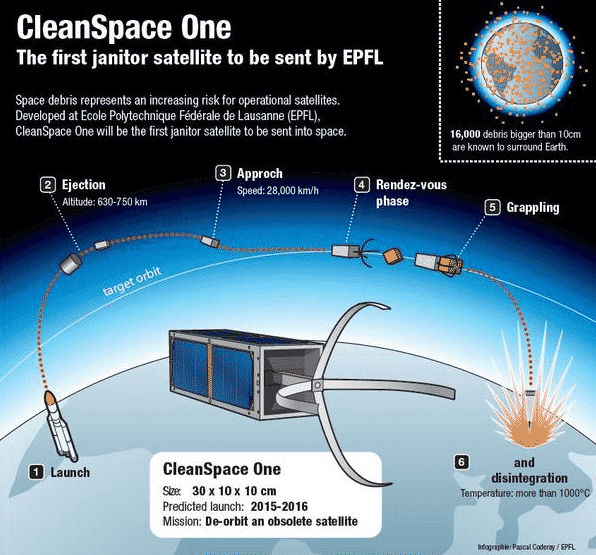
The debris at space travels at 17,500 miles per hour speeds. It is so fast that it can destroy or inflict expensive and time-draining damage on a satellite or spacecraft. Moreover, this debris’ are larger than 4 inches across. Therefore, probability of collision is high and if collisions happen it generates thousands more fragments that will float in space. The U.S. space agency NASA said, “Over 500,000 pieces of spent rocket stages, broken satellites and other debris are orbiting Earth.” t know more about debris, click here.
Most of us doesn’t know, space junk has already collided with satellites twice. One happened in 1996 another happened in 2009. In 1996, a French satellite was damaged by a rocket fragment and in 2009, a satellite owned by U.S. based Iridium Communications was destroyed in a collision with a derelict Russian satellite. Claude Nicollier, an astronaut and EPFL professor said, “It has become essential to be aware of the existence of this debris and the risks that are run by its proliferation.” Check out the video below.
Till now, sounds really good and interesting? Isn’t it? Just build up a new satellite, send it to the space, it will find the space enemy, destroy it, and make the world safe and sound. Wow! What a cool idea! No cache, no barriers, no hurdles? I wish, if that would happen as what I said. Aha! Finally you got it. Yes, my friends! There is hurdles, barriers and caches. Now coming to that part.
Building a new satellite means developing a new technology. But according to scientists, to develop this new technology they have to face not one, not two but three big problems. Here are the problems:
Problem # 1 : It’s the Trajectory. The satellite needs to be able to adjust its path in order to match that of its target. EPFL’s labs are looking into a new ultra-compact motor that can do this.
Problem # 2 : The satellite must be able to grab and stabilize the debris at high speeds. Scientists have no options but they are studying how plants and animals grip things as a model for what would be used. By the way, are they studying on man eating trees/plants or how tigers or snakes catch their super fast prey?
Problem # 3 : The new Janitor satellite ‘CleanSpace One’ must have the power and capability to guide the debris or unwanted satellites back into Earth’s atmosphere. It’s like the teacher order something and the student will obey that. While the debris or unwanted satellites or both are in Earth’s atmosphere, the Swiss made satellite will burn them.
Climax :
After finishing the job completely, each satellites will be destroyed after its mission. But, creating such satellite is very costly. If the predator(satellite) becomes prey, then why it needs to be completed so perfectly and costly, when its destiny is to be ruined. Money is like rising from the east like the sun and destroyed(sets) in the west and next following days, it goes on and on and on…
In 2007, China purposely destroyed one of its own satellites with a missile in a test, putting an estimated 150,000 smaller pieces of debris into space and 3,000 big enough to be tracked by radar on the ground. More recently, Russia’s $170 million planned Mars moon probe got stranded in Earth’s orbit after its Nov. 9 launch. Efforts by Russian and European Space Agency experts to bring it back to life failed. It was one of the heaviest and most toxic pieces of space junk ever to crash to Earth.
At present, EPFL scientists are working on to create a motor which will be so powerful to keep up with the debris, which can travel at speeds of 28,000 kilometers per hour (approximate 17,400 miles per hour), and to find a gripping mechanism that can keep hold of the rotating, fast-moving objects. If the assuming project becomes successful, the satellites can then start taking out some of the roughly 16,000 pieces of space junk.
U.S. Secretary of State Hillary Rodham Clinton warned last month of the space environment is threatened by space junk, and said the U.S. will hold talks with the European Union (EU) to set informal rules aimed at limiting debris. CleanSpace One will be launched within 3-5 years and its first tasks will be to grab two Swiss satellites that were launched in 2009 and 2010.
Source : EFPL
Image Credit : EPFL