
Did you ever hear of it? Wireless electricity. How can it be possible to transfer power without cable? It’s not a new idea. Scientists are researching on it for about 100 years. But it’s only few years that it has come to reality. Though, it’s in initial experimental state, I am sure it has a bright future, if the scientists are successful. Just think, the electricity is movie like your data on the air. Unbelievable! So far only one device could be powered through wireless electricity. Recently, MIT WiTricity team powers two devices simultaneously. They come to the point that using magnetic induction to send electricity to devices is more efficient when more than one machine is involved. The efficiency of the energy is better for multiple machines.
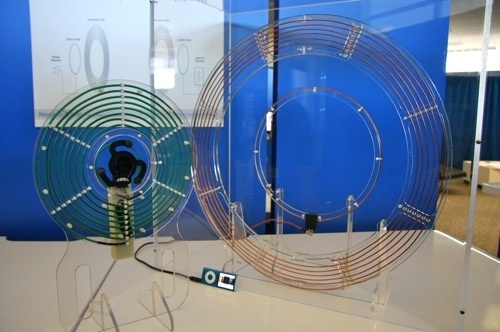
Before, high-powered microwaves to focused beams of infrared had being tested. But researchers at the Massachusetts Institute of Technology (MIT), led by physicist Marin Soljacic, think using magnetic fields to induce a current in a distant device is the most promising approach. They tune the transmitter and receiver to magnetically resonate at the same frequency to maximise efficiency. Waves carry energy most effectively between objects that resonate at the same frequency, an effect at work when a singer smashes a nearby glass with the right note.
Previously, an MIT WiTricity team powered a 60-watt light bulb from across the room using a magnetic coil. That was 2007.
Yesterday, that MIT team has shown it is possible to power two devices, wirelessly, when the are placed on either side of a single 1-sq. meter coil. The effective distance from coil to device was anywhere between 1.6 to 2.7 meters. Cooler still, the researchers discovered that by using two devices the power transfer was 10% more effective than using just one. Additionally, the researchers’ models suggest that the efficiency would increase even more should they try and introduce more devices into the mix.
According to New Scientist:
That makes it possible to power a collection of devices with poor individual links, perhaps because they are scattered across a room far from the coil. “We could have reasonably good efficiency over a room-sized area from a coil embedded in ceiling or a wall in order to power multiple gadgets or devices,” said Kurs. The efficiency increases because more of the broadcasting coil’s field falls on receptive receivers.
“This is a promising road to full wireless connectivity, not just for signals but also for power,” says electrical engineer Luk Arnaut of Imperial College London. “However, the efficiency of the system rapidly deteriorates with increasing distance,” he adds, explaining that specialised antennae will need to be developed to counter that.
The MIT researchers have set up a spin off company called WiTricity Corporation, joining electronics firms such as Sony in trying to commercialise wireless electricity transfer.
The end game is a wall or ceiling-mounted coil that would wirelessly power an entire room of gadgets. One remaining issue is distance: When the devices are moved outside the 1-2 meter range, the signal deteriorates rapidly, as would be expected. Fortunately for wireless power buffs, MIT is working on a specialized antenna to counter the weakening signal.
Just watch this funny but informative video
Source: New Scientist, Gizmodo



please end me the required components with required ranges to do the Wireless power transmission project…..Please hep me
Afraid to patent my invention,Because I had been scammed:my motor;fuelless,and no batteries:2 disk,with 30 magnets around its edges,number one disk;is mounted permanently,number two disk;with similar amount of magnets,around its edges,is the revolving disk,through a simple clutch system,when,the number two disk is in close to the first disk?it would spin,to stop the motor?just unclutch,and the speed would slow down,this motor i invented ,could be used for submarine,cars,electricity-plant for the home,helicopters,and boats,for example ,from a mere 12volts,can be made up to 110 or 220,volts thru a step up transformer,no out side scource,is needed,if neodyminm magnets are used?it can last a long long time;and were talking about a single deck;if this motor is built in multiple deck?it would be very very powerful,and ariel plat-form akin to a helicopter,can be used to protect military air-fields,and no RPG,s or gun fire can shoot it down,because it is armour plated,with titanium-insulated,between the armour plates,in the shape of honey-combs,if weather is stormy?it can hover few feet from the ground,,or stored into it,s hangers.Ernest.DIzon@Ymail.com;the secret of this motor is in the shape of the magnets,it uses repulsion as its power scource,I had inquire into the cost of making those Magnets,and it is very expensive,but with goverment funds;could start right away ,for the benefit of all Mankind.