
The world’s first store for 3D printed goods just opened in Brussels and MIT Media Lab work on a project of 3D Printed Flute.Their goal is to create an instrument via 3D printing that works as a traditional instrument and this 3D printed concert flute rapidly brings prototypes sound……….
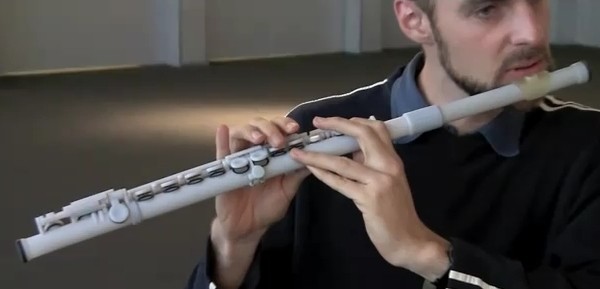
MIT Media Lab researcher Amit Zoran attempted to print an entire and working flute in one operation.This feat involves not only producing the moving parts, but also ensuring that the integrity of the entire “system” is sufficient to produce beautiful music. According to Zoran:
Our goal is to produce a flute using 3D printer technologies, a flute that is compatible with a traditional concert flute both acoustically and ergonomically.
Number of challenges :
- Printing a complex design involving multiple moving parts
- Achieving air-tight surface joins suitable for musical note production, using soft material
- Producing the right physical “feel” for the musician using different materials (a key feature of the Objet Connex500 3D printer used in this project)
- Ensuring “perfect” sounds, at least according to flutist Seth Hunter
The 15 hour print involved producing 4 parts, which with some non-3D printed springs were assembled into the final flute. Huge amounts of support material used, which is inevitable given the amazing number of movable parts and overhangs in the complex design.The project also envisions designs for musical instruments that are entirely new possibly leading to new forms of music in the future.

Creating novel instruments sounds like a good idea. I just hope these 3D printers aren’t used to make even tackier, even cheaper plastic rubbish toys
This is my first time I visit here. I found so many interesting stuff in your blog especially its discussion. From the tons of comments on your articles, I guess I am not the only one having all the enjoyment here! Keep up the good work.
This is a nice blog. I will be coming back soon, Thanks for posting some great ideas and I’ll try to return back with a completely different browser to check things out.
3D printed Flute is very nice invention. It is very challenging invention. But MIT Media Lab researcher Amit Zoran accept this challenge and invent it.
I would really like
to say thanks a whole lot for that work you have made in writing this blog
post.