
Once upon a time people who had Cancer must die because there was no cure of it. People were very afraid of this disease. Later it’s cure and treatment released. But though advanced technology and treatment we have now, people are dying because of cancer. Scientists from Wyss Institute for Biologically Inspired Engineering at Harvard University have created a robot made which is from DNA. This robot is capable to find diseased cells in the body and deliver a payload to kill. If not possible, then it will reprogram them. Wow! We are going to have a new doctor named Dr. DNA Robot, specialized in Killing… Cancer Cell!

Researchers from Harvard University have created a barrel-like robot which they call it nanorobot that can bind to cancer cells and deliver messages telling them to self-destruct. For this, they have used a technique that folds DNA into unique structures. In other word, it can be called ‘DNA Origami’. This is a very cool design concept. The researchers have become successful in an experiment. A robot was made by folding DNA strands into a shape likely a clamshell. The researchers programmed the nano-sized device to open in the presence of leukaemia and lymphoma cells in a laboratory dish. In this lab they delivered immune system antibodies that caused the cells to self-destruct.
Ido Bachelet, a postdoctoral fellow at Harvard Medical School in Boston, Massachusetts said, “We call it a nanorobot because it is capable of some robotic tasks. It automatically changes its shape and delivers its cargo.” For more details you can click here.
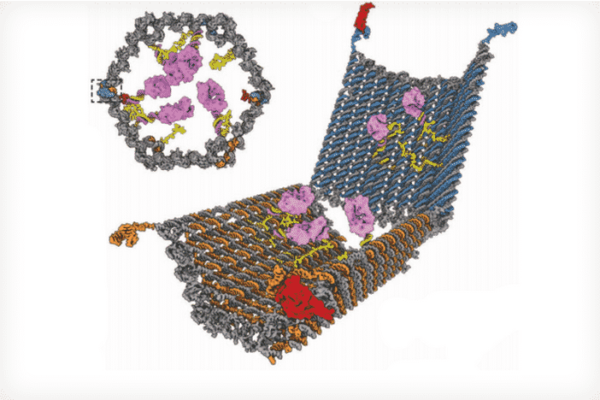
The open-source software is called Cadnano, developed by Shawn Douglas. In DNA origami each barrel-shaped devices were about 35 nanometres in diameter. It contains 12 sites on the inside for attaching payload molecules and two positions on the outside for attaching aptamers, short nucleotide strands with special sequences for recognizing molecules on the target cell. The aptamers act as clasps. Once the target is found, they spring open the device to release the payload. To know more, click here.
Robot are being prepared in such a way so that it can circulate longer to locate all cancer cells in the body. But, the technology isn’t ready for commercial use. The robots are inspired by the body’s natural immune response, which normally our immune systems don’t accept. But with the help of Nano-robots, it can be cleared out quickly. Now, researchers are testing the system in mice.
[ttjad]



“capable to find” sounds very awkward. “capable of finding” sounds much better to me. Actually the whole article is awkward yo read.