Hubble telescope snapped very rare image of Saturn. NASA reveled those pictures & a video a few days ago. Sorry guys, I am late for this news. The Hubble space telescope has captured the dazzling glow of Saturn’s twin auroras as they light up both poles of the planet simultaneously. It’s a very rare photo, as both poles and rings are visible.
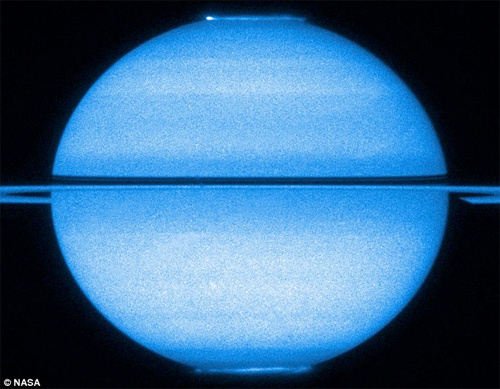
The opportunity to image both of Saturn’s poles occurs only twice in its 30-year orbit – so it wasn’t until 2009 that Hubble got the chance to image Saturn with the rings edge-on and both poles in view. At the same time Saturn was approaching its equinox, so both poles were equally lit by the Sun.
The magnetic field is stronger at the poles, and the particles tend to concentrate there. They interact with atoms in the upper layers of the atmosphere, creating aurorae – the northern and southern lights.
The rare footage reveals slight differences between the auroras, with the glowing lights in the north being smaller but more intense than those in the south. The effect is caused by Saturn’s magnetic field being unequally distributed across the planet and stronger in the north.
As a result, the electrically charged particles in the north are accelerated to higher energies as they are fired toward the atmosphere than those in the south. This confirms a previous result obtained by the space probe Cassini, in orbit around the ringed planet since 2004.
Sadly, this is the only chance you’ll get at having Saturn’s aurorae as your desktop wallpaper, as the angle from which they can be viewed at is only possible twice every 30 years, and the Hubble telescope will no longer be used when the next opportunity comes along.
Sources: The Guardian, Gizmodo, TGDaily