Medal of Honor is not a new name for shooter fans, but with the latest upcoming version the franchise is entering new territory. It’s being moved into a modern setting as US forces tangle with hostiles in the hills of Afghanistan. The single-player portion is being handled by EA Los Angeles, which has been in very close contact with the US armed forces to help craft a product that looks, sounds and feels authentic. The multiplayer portion, which we don’t really know anything about yet, is being worked on over at DICE, the studio responsible for the Battlefield franchise. Looking at that studio’s track record of creating some of the most thrilling online shooter experiences around, then that has to mean good things, or so we all hope. The focus of this preview is the campaign mode, a small portion of which was shown off during a recent demo session. Will Medal of Honor restore balance to modern-day combat? Here are a few reasons it might:
It’s a more realistic scenario
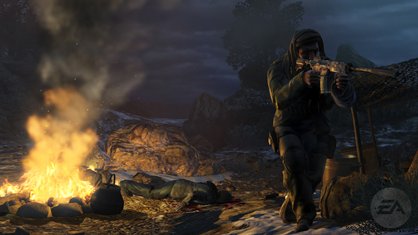
Rather than taking place in SHIT-THE-WHOLE-WORLD-IS-BLOWING-UP-ISTAN, Medal of Honor is set in present-day Afghanistan, and deals with the current military operations occurring there. But that doesn’t mean it’s just a bunch of deserty nothing – Afghanistan is a very geographically diverse country, so there’s plenty to see.
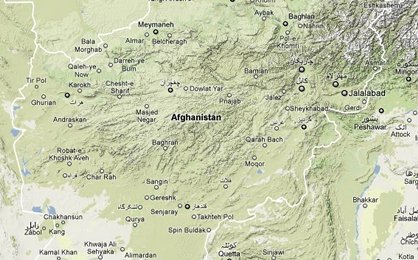
Above: Plenty to see (image via Google Maps)
We don’t know much about the plot, other than that it involves two types of missions, “sledgehammer” assaults and “scalpel” operations. Sledgehammer-style missions are big military operations – the kind used to attack, acquire, and hold ground. Infantry and vehicles are utilized in numbers, and the violence enacted is forceful and wide spread. Attacks with the proverbial scalpel are the opposite – they involve the super-hardcore Tier 1 Operators, who are heavily specialized and precise.
The campaign is being orchestrated by EALA with help from military experts, some of whom are currently deployed overseas. The development team sends gameplay DVDs to these experts, and makes adjustments in accordance with the commentary they receive. They’re very serious about keepin’ it real.
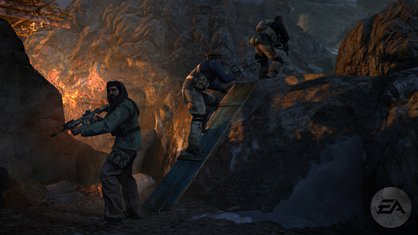
Above: Real.
It’s more thoughtfully paced
It’s less “SHIT! DO EVERYTHING RAMIREZ!” and more silence… silence… silence… “Go loud.”
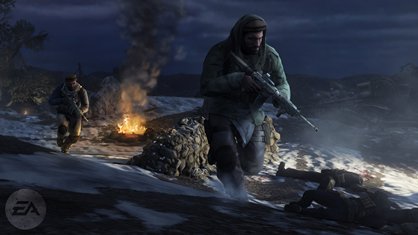
The mission we saw was one of the Tier 1 missions, so the action was carefully plotted. The unit’s task was to invade a mountainous encampment and disable anti-air weaponry to make way for incoming helicopters. The team darted between cover points and chatted on their radios as situations developed, occasionally making mistakes and correcting themselves, which created a believable ambiance.
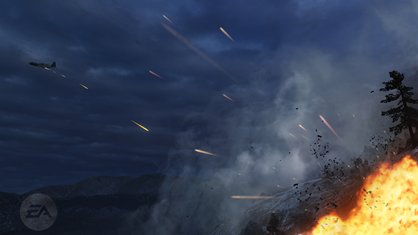
But the calculated approach wasn’t devoid of big set pieces and surprises. Helicopters blew the crap out of a caravan, an anti-aircraft installment was neutralized with C4, and the operators encountered more than expected when they breached a larger town, resulting in a frantic firefight which broke their Zen-like calm.
And, of course, the “sledgehammer” missions will likely be even more extravagant, as they involve much larger operations, and will incorporate air and land vehicles.
It plays with storytelling mechanics too
Like Modern Warfare, you’ll play as multiple characters throughout MoH, and actions you take as one character will affect missions you play later as other characters. For example, in a mission prior to the one we witnessed, the player encountered a convoy, but didn’t have the means to destroy it, so all he could do was drop IR beacons on it to mark it as a target. In the mission we saw, that same convoy came around a corner, blinking “kill me, kill me, kill me,” and a friendly helicopter turned it into a light show.
We’ve been informed of three characters – two “sledgehammer” characters, an Army Ranger and an Apache Pilot, and one Tier 1 character, the bearded dude who’s on the cover (the beard isn’t just for show – he’s blending in with the locals to aid infiltration).
The multiplayer is being developed by DICE
EALA knows their strengths – they’ve got the campaign covered. But to avoid taking developers off the campaign, potentially compromising its quality, and potentially botching the multiplayer aspect, they’ve handed the entire multiplayer job to the very capable DICE.
Of course, EALA is ensuring that the multiplayer section and campaign fit together coherently, but other than that, DICE is taking charge. They’re developing the mode on their own engine (the campaign runs on Unreal tech, but the multiplayer will run on DICE’s Frostbite engine – the same engine used in Bad Company 2), and they’re building their own maps, so we won’t see the typical campaign rehash maps. Possibly big, Modern-Warfare-2-killing things.

Source: Gamesradar