
Apple has seen a major surge in it’s growth even since the inception of iPhone and iPad series. Millions of units have been shipped and millions more are expected to ship out in the coming days. Alongside, Apple’s MacBook series is also doing a very good job on the sales. All this has made Apple the largest buyer of semiconductors worldwide, spending about $17 billion on them in 2011. Second in the list is Samsung followed by HP, Dell, Nokia and Sony respectively. It’s surprising to note that Apple manufactures limited products while Samsung deals with a greater range of electronics – yet Apple has taken the lead on this front too.
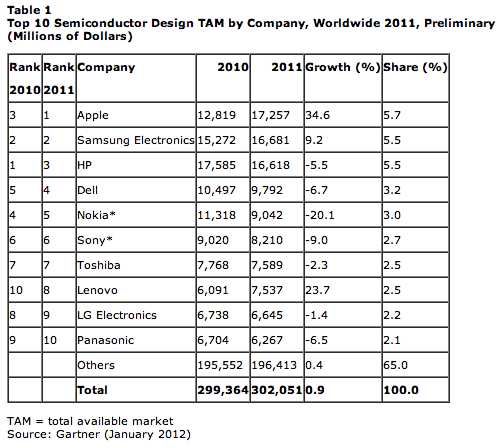
This latest list comes from a research firm, Gartner. According to Gartner, Apple’s purchases of the semiconductors accounted for about 5.7 percent of the total silicon buying in 2011. And this percentage may well rise in the coming days with the huge anticipation that is surrounding the release of iPhone 5 and iPad 3.
Samsung and Hewlett-Packard are close behind though. Samsung’s purchases amount up to $16.7 billion which is about 5.5 percent of the overall purchases while those of HP stand at $16.6 billion. Next in the list are Dell and Nokia with spendings worth $9.8 billion and $9 billion respectively.
Apple’s lead in this front is very interesting. It’s rivals, specifically Samsung, deals with a very large range of electronics. It produces from fridges and ovens to computers, tablets, smartphones and lot more. Yet Apple beat Samsung in the overall consumption of semi-conductors. This clearly tells how excellent Apple is doing in the limited domain of products it is rolling out, relying heavily on iPads and iPhones. Even more interesting is the fact that Apple is on the lead even when a huge portion of Apple’s A5 chips for iPad and iPhone are being manufactured by it’s rival, Samsung. Samsung spent more than $3 billion recently to set up a chip factory in Texas to cater to the chip-needs of Apple.
[ttjad keyword=”ipod-touch”]