The creation of Harry Potter-style invisibility cloaks may be closer than you think.
German scientists have found a way to make an object vanish from view in three dimensions for the first time, according to a study published in the journal “Science.” The researchers placed a “cloak” over a tiny lump of gold and distorted the lighting, hitting so it appeared invisible.
“We put an object under a microscopic structure, a little like a reflective carpet,” said Nicholas Stenger, one of the researchers from Karlsruhe Institute of Technology who worked on the project.
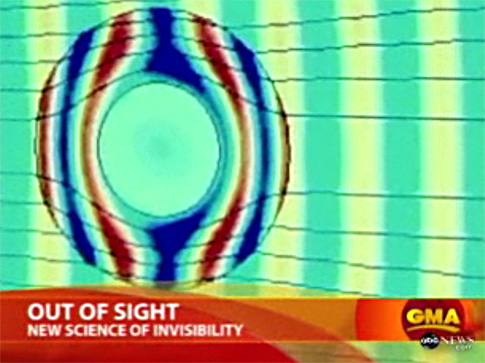
These scientists have published their finding in the journal Science and in their study, Ergin and his colleagues used photonic crystals with a structure that looks like piles of wood to make an invisibility device, or cloak. Transformation optics use a class of materials called metamaterials that guide and control light. It is possible that in the future make it possible large objects invisible, but for now the researchers said they were not keen to speculate on possible applications.
They used the cloak to conceal a small bump on a gold surface — a bit like hiding a small object underneath a carpet and then making both the bump and the carpet invisible. The “cloak” was composed of special lenses that work by partially bending light waves to suppress the light scattering from the bump. “This is very exciting, because mankind has always thought about being invisible or having invisibility cloaks,” Ergin told Reuters in a telephone interview. “This is the first proof of principle. It shows that the technique works.”
He added, however, that it would be many years before anything as large as a person, car or tank could be made to disappear with this technique. “There have been proposals in the field of transformation optics for different devices like beam concentrators, beam shifters, super antennas which concentrate light into one point from all directions, and much, much more. It is really hard to say what the future will bring, but the field is definitely very broad and the possibilities are very large.”