Is there life out there? That is a question that has baffled scientists for decades. The search for aliens has fascinated scientists even before the first man landed on the moon. The traditional approach has been the use of radio telescopes but this has so far yielded nothing.
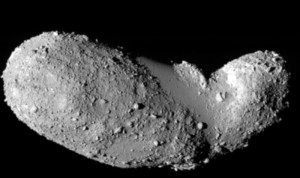
Some scientists are suggesting a different approach to locating aliens in our galaxy – look for signs of asteroid mining. Sound strange? Probably. The logic is that there is a chance that the aliens out there could be digging up asteroid surfaces as they look for precious metals. And mining activity would be difficult to miss given the amount of dust it is likely to throw up in the asteroid’s atmosphere.
The argument for mining-activity detection draws from humanity’s own process of civilization. That is, that as human beings strive for inter-planetary travel and space exploration, such technology requires certain raw materials if it is to succeed.
For aliens, comets, asteroids and other forms of interplanetary debris may be a rich source of such metals and raw materials. The assumption here of course is that the civilization of such aliens is more advanced than human civilization.
One of the first hints of such mining would be the debris rising up and forming a ring around the asteroid. The second hint would be a noticeable change in the size of the planetary body in question in the wake of extensive mining operations.
Duncan Forgan and Martin Elvis of the University of Edinburgh and the Harvard Smithsonian Center for Astrophysics are the two scientists that have floated this theory that was recently published in the International Journal of Astrobiology.
The two scientists have been careful though to clarify that their concept is not the end-all technique for finding extra terrestrial beings.
[ttjad keyword=”general”]