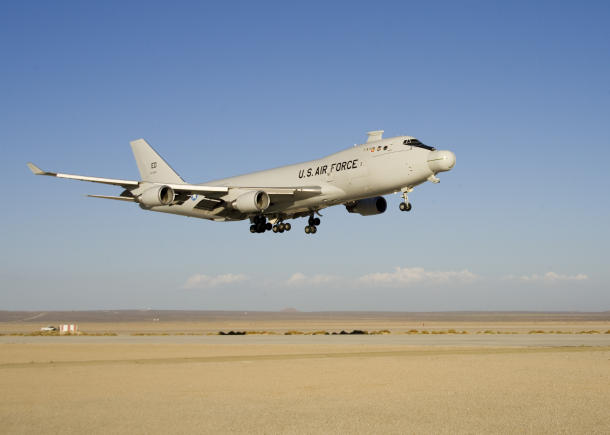
On February 11, US military have tested a successful program. They blasted off a ballistic missile using a high energy laser. The Airborne Laser Testbed (ALTB) – which was mounted on the nose of a modified Boeing 747-400F – intercepted the “enemy” projectile during its boosting phase by burning a hole in the missile’s side. The shootdown took place off the central coast of California.
It’s one of a number of steps forward for real-life ray guns in the past year or so. “Solid state” electric lasers finally hit what’s commonly considered battlefield strength. A laser-equipped Air Force gunship disabled a truck with its energy beam. A ground-mounted ray gun blasted drones out of the sky. But all of those energy weapons were weak — and the engineering challenges limited — compared to last Thursday night’s shoot-down.
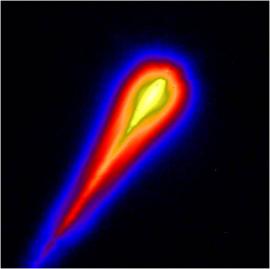
In 1983, President Ronald Reagan supported a program designed to shoot down Intercontinental Ballistic Missiles (ICBM) which raised protest and skepticism — if such a technology was even possible — six years after the movie Star Wars debut. Billions of dollars were invested in a variety of research programs. The military has methodically researched a variety of concepts on how to defend against incoming nuclear missiles. SDI was born and today is managed by the U.S. Missile Defense Agency.
Ground-based systems were never seriously considered because of many obstacles that could occur between the ground station and the target and the limited amount of area that it could protect.
Spaced based systems are ideal, but posed significant technical, financial and security challenges. Throughout the 1990’s, the program evolved, and continues down two primary paths. One is using ground based missiles to hit opposing missiles such as the Patriot system and the second is using aircraft with the payload that is then fired to intercept an ICBM. The latter concept has continued development as a satellite attack platform.
Modifying the second approach evolved using large airborne platforms to house powerful high powered (as in multiple Megawatt) based lasers. The program offered several advantages:
1. It’s rechargeable.
2. It an be stationed anywhere over the United States and its allies.
3. it can be above any obstacles between itself and the target.
In 2004, a B-747-400, heavily modified to be used as the test platform, known as the YAL-1A, was built.
A short-range, Scud-like ballistic missile was launched from an at-sea mobile launch platform near the Point Mugu Naval Air Warfare Center, off of the central California coast. “Within seconds, the Airborne Laser Test Bed [ALTB] used on-board sensors to detect the boosting missile and used a low-energy laser to track the target. The ALTB then fired a second low-energy laser to measure and compensate for atmospheric disturbance. Finally, the ALTB fired its megawatt-class High Energy Laser, heating the boosting ballistic missile to critical structural failure. The entire engagement occurred within two minutes of the target missile launch, while its rocket motors were still thrusting.
This is a test the MDA was hoping to conduct in 2002, after spending about a billion dollars. But the Airborne Laser ran into all kinds of problems along the way. The chemicals the jet depended on to generate its high-strength laser weighed down the 747. Getting the laser to accurately zap through the atmosphere proved tougher than anticipated. The Airborne Laser eventually ballooned into a $7.3 billion project. Finally, Defense Secretary Robert Gates got so fed up, he told the MDA to end the Airborne Laser program after a single jet.
“I don’t know anybody at the Department of Defense who thinks that this program should, or would, ever be operationally deployed,” Gates told Congress last year. “The reality is that you would need a laser something like 20 to 30 times more powerful than the chemical laser in the plane right now to be able to get any distance from the launch site to fire.”
“The Airborne Laser Testbed team has made history with this experiment,” said Greg Hyslop, vice president and general manager of Boeing Missile Defense Systems, in a statement released Friday. Boeing is the prime contractor for the Defense Department project.
The U.S. Missile Defense Agency was equally enthusiastic about the results. “The revolutionary use of directed energy is very attractive for missile defense,” the agency said in a statement, “with the potential to attack multiple targets at the speed of light, at a range of hundreds of kilometers, and at a low cost per intercept attempt compared to current technologies.”
A Chemical Oxide Laser is housed in the aircraft and is going through testing to destroy short and long range ballistic missiles. On Wednesday just before 9 PM Pacific time, the second successful test was completed.
At 8:44 p.m. (PST), February 11, 2010, a short-range threat-representative ballistic missile was launched from an at-sea mobile launch platform. Within seconds, the ALTB used onboard sensors to detect the boosting missile and used a low-energy laser to track the target. The ALTB then fired a second low-energy laser to measure and compensate for atmospheric disturbance. Finally, the ALTB fired its megawatt-class High Energy Laser, heating the boosting ballistic missile to critical structural failure. The entire engagement occurred within two minutes of the target missile launch, while its rocket motors were still thrusting.
This was the first directed energy lethal intercept demonstration against a liquid-fuel boosting ballistic missile target from an airborne platform. The revolutionary use of directed energy is very attractive for missile defense, with the potential to attack multiple targets at the speed of light, at a range of hundreds of kilometers, and at a low cost per intercept attempt compared to current technologies.
According to the DoD, directed energy platforms can eventually be deployed to intercept multiple, fast-moving targets at a range of hundreds of kilometers.