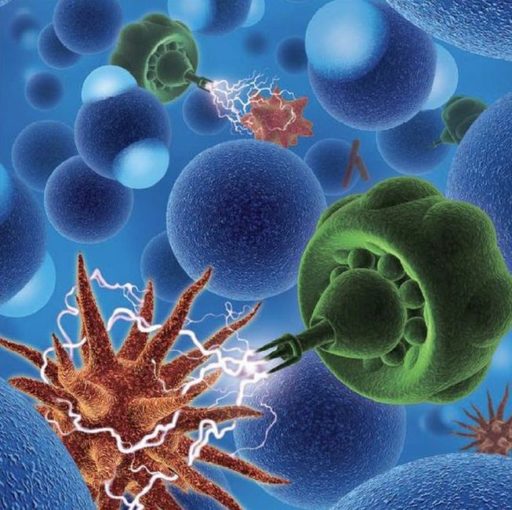
Scientists at the University of Pittsburgh have made a giant leap in the direction of working nanotechnology. They have created artificial cells that can talk to one another and cooperate to carry out a task. This breakthrough could eventually lead to artificial cellular systems that perform highly specialized jobs at the microscopic level, that is, practical working nanotechnology.

The artificial cells are more like microcapsules that can move independently and deposit cargo wherever it’s needed. But directing these microcapsules — or more accurately, getting them to direct themselves — is the real breakthrough. By secreting special nanoparticles, the microcapsules are able to communicate (video here), assemble into groups (video here), move in tandem, or deposit their cargos just like living cells can. But unlike living cells, the lack the complicated biochemistry that can make living cells so hard to manipulate.
To communicate, a signaling cell will secrete special nanoparticles known as agonists that prompt the target cell to respond by secreting different nanoparticles known as antagonists. When the antagonists reach the original signaling cell, it stops secreting agonists. Once the signaling cell goes silent, the target cell does the same (it was only secreting antagonists in response to the agonists). At that point, the signaling cell knows to start signaling again.
This cycle locks the two into a cycle that can be thought of as a conversation. Engineers can manipulate that conversation by adjusting the nanoparticles themselves, the capsules’ permeability, and the number of nanoparticles each one is given.
But how do the microcapsules know where to find each other? That’s the neatest trick of all: the Pitt engineers devised a method — with a tip of the hat to ants — wherein the capsules leave a chemical trail behind them as they move about. That trail prompts other microcapsules to follow, just as ants follow one another along a perfect trail even though the trail isn’t marked. Such an ability to gather, follow, and cooperate could make for highly targeted drug delivery systems or carry out super-precise chemical processes in the lab.
Source: Popular Science.