
Eminent biologist Professor Frank Fenner, who helped to eradicate smallpox, recently made the dire prediction that humans will probably be extinct within the next 100 years due to overpopulation, environmental destruction and climate change.

Fenner, who is emeritus professor of microbiology at the Australian National University (ANU) in Canberra, said homo sapiens will not be able to survive the population explosion and “unbridled consumption,” and will become extinct, perhaps within a century, along with many other species. United Nations official figures from last year estimate the human population is 6.8 billion, and is predicted to pass seven billion next year.
Fenner told The Australian he tries not to express his pessimism because people are trying to do something, but keep putting it off. He said he believes the situation is irreversible, and it is too late because the effects we have had on Earth since industrialization (a period now known to scientists unofficially as the Anthropocene) rivals any effects of ice ages or comet impacts.
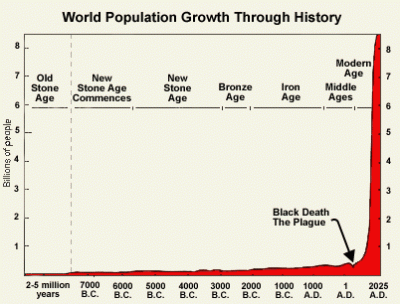
Enlarge
World population growth chart.
Fenner said that climate change is only at its beginning, but is likely to be the cause of our extinction. “We’ll undergo the same fate as the people on Easter Island,” he said. More people means fewer resources, and Fenner predicts “there will be a lot more wars over food.”
Easter Island is famous for its massive stone statues. Polynesian people settled there, in what was then a pristine tropical island, around the middle of the first millennium AD. The population grew slowly at first and then exploded. As the population grew the forests were wiped out and all the tree animals became extinct, both with devastating consequences. After about 1600 the civilization began to collapse, and had virtually disappeared by the mid-19th century. Evolutionary biologist Jared Diamond said the parallels between what happened on Easter Island and what is occurring today on the planet as a whole are “chillingly obvious.”
While many scientists are also pessimistic, others are more optimistic. Among the latter is a colleague of Professor Fenner, retired professor Stephen Boyden, who said he still hopes awareness of the problems will rise and the required revolutionary changes will be made to achieve ecological sustainability. “While there’s a glimmer of hope, it’s worth working to solve the problem. We have the scientific knowledge to do it but we don’t have the political will,” Boyden said.
Fenner, 95, is the author or co-author of 22 books and 290 scientific papers and book chapters. His announcement in 1980 to the World Health Assembly that smallpox had been eradicated is still seen as one of the World Health Organisation’s greatest achievements. He has also been heavily involved in controlling Australia’s feral rabbit population with the myxomatosis virus.
Professor Fenner has had a lifetime interest in the environment, and from 1973 to 1979 was Director of the Centre for Resource and Environmental Studies at ANU. He is currently a visiting fellow at the John Curtin School of Medical Research at the university, and is a patron of Sustainable Population Australia. He has won numerous awards including the ANZAC Peace Prize, the WHO Medal, and the Albert Einstein World Award of Science. He was awarded an MBE for his work on control of malaria in New Guinea during the Second World War, in which Fenner served in the Royal Australian Army Medical Corps.
Source: Physorg.com

Fenner's forecast mirrors one made last year by John Beddington, England's chief scientific advisor, who warned that climate change, population growth, and the world's rising demand for food, energy and water constituted a “perfect storm.” Expanding upon that conjecture, the Population Institute (http://www.populationinstitute.org) today released 2030: The “Perfect Storm” Scenario, a report that examines in more detail the threat identified by Beddington. For more information go to: http://www.populationinstitute.org/newsroom/new…
Robert J. Walker, Population Institute
This would be a lot more convicing if Anthropogenic Global warming wasn't proven false so often.
http://www.americanthinker.com/2009/11/global_w…
http://www.climatechangefraud.com/
Also, it would probably help if the Black Death (which occured about 1350 AD) wasn't pictured closer to 1 AD than it is to 2025.
The 1000 A.D. and the 1 A.D. markers have switched places.
WE NEED MORE GAY/LEZ PEOPLE! Lucckily I’m one of em. 😀
nasty..fagget
nasty..fagget
nasty..fagget
Prof Fenner is correct.
Unless we change our ways, by living frugally, educating people – no more than 2 children per new family, switch to clean energy, and return to our roots of becoming veegan as Pres. Bill Clinton e did, ( see in google DNA explains why this works : “beyond bones and stones” ) we will indeed become extinct.
Agribusiness pollutes 51% and fossil fuels, and fossil fues, overpopulation, deforestation etc, do the rest of pollution, causing global warming.
Animal products because it is killing us with heart attacks, strokes and cancer, plus destroying our farmlands. ( see Dr. C Esseslteyn, and Dr. Campbell – The China Study)
Prof. Lester Brown calculates that if we take 12 % of worldwide military budgets to retool machinery, so it can be powered by electricity, use solar and wind power, we can easily revert global warming , decease famine and improve family planning education with that $$ so the predictions do not occur.
The catch is, that we only have 8 years to do it or it will be too late.
Please watch in youtube HOME by Yann Arthus. It will show what is at stake. Skipt the intro. It is 90 minutes long. Please pass this on.
G Kaplan, MD lifewatchgroup.org
Fuck off! Shut up you loser!
i’m going to spell this out for you slowly, global. warming. isn’t. real. the temperature fluxuates often, it went up 1 degree average and eveyone’s freaking out that the world is going to burn up
Interesting article. Forget global warming as professed by the Progressives and just look at the population explosion. Progressives have created part of the problem by encouraging single moms to have multiple births to be supported by working people. The better educated have dropped the number of kids they have but then have to support those who breed at will. China’s policy of 2 kids is an admirable effort to hold down their population but Politicians in the U.S. need votes and won’t stop the breeding cycle here in the States. Like wise those countries who have multiple wives and multiple kiddies are not going to slow down.
I don’t see us becoming extinct but will bet on more wars using WMD’s to cull the population.With more and more productive land being paved over the ability to have food produced will be less and less along with water shortages.
With in 10 years I will bet the bank water will be more expensive than gas and riots will be all over the place demanding food,water and shelter as the have’s out pace their ability to support the have nots.
I’m going to spell this out for you only use better spelling. You are a fcuking idiot!!