
People looking to cosmetic treatments to get rid of age lines and facial spots now have an alternative treatment as an option. An inventor in London is claiming that using the “latest NASA technology” which has already been tested on astronauts and the US Navy, he can diminish lines and spots. The device is called pictured and is called The Light Masque.
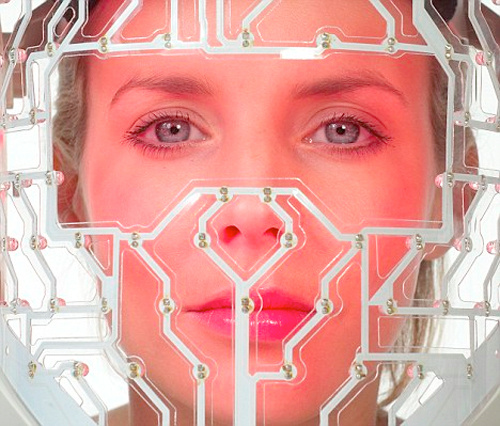
With blue LEDs medicating spots and rosacea, and red LEDs “supercharging” skin cells and going even deeper, the inventor of the Light Masque John Tsagaris reckons his patients see effects after the first 25 minute session, but should have three sessions a week for two weeks just to ensure results stay. At £75 ($115) per session, it may be cheaper to just get botox.
Tsagaris is a doctor of Chinese medicine (he has a degree in traditional chinese medicine combined with human bioscience and also holds a postgraduate diploma in skin disorders and beauty care).
His work has included placements in hospitals in Beijing, where he specialised in dermatology, gynaecology, cardiology and geriatrics, and he now has a clinic just off Harley Street and does the odd day at Harrods’ new MediSpa. But why a light-emitting helmet?
”This is something for the 21st century,” says John, ”using the latest NASA technology.”
”NASA has been researching the potential of LED [light-emitting diode] light and has adapted it to use on astronauts and for the U.S. Navy. It also lifts energy levels, making patients feel full of life.”
A woman sunbathes
Treatment: The Light Masque claims to restore the skin’s natural ability to reduce sun damage
It is a non-invasive procedure, he explains, that delivers low-level pulses of light up to three times brighter than the sun.
‘This light is accelerating the energy potential of skin cells, working particularly on the mitochondria, the energy factory that is inside each cell.
”The light works like photosynthesis for the skin by converting light energy to promote healing and anti-ageing effects at a deep level. It also works on preventing bacteria in the skin.”
How can light do this? Well, there is a lot of research into LED light treatments and what they can do for the skin.
Unlike laser light (it’s a different wavelength), LED is gentle on the skin. Blue LED light is good for treating acne and rosacea, as it affects the ‘superficial’ levels of the skin to tackle bacteria and inflammatory conditions. Red light goes deeper, to affect the collagen production in the skin, supercharging the cells.
One U.S. study reported a ”statistically significant improvement in wrinkles”, while another showed ”a reduction in the signs of photoaging in 90 per cent of subjects, with smoother texture, reduction in peri-orbital rhytids [that’s crow’s feet] and reduction in erythema [redness] and pigmentation”.
Source: Daily Mail.


I am not much into reading, but somehow I got to read this article
and I like this because it is wonderful and informative too.This blog is very effective for me..
Thanks for posting…
Avalon granite and
marble is a full granite and marble company. Avalong Granite and marble
specializes in granite countertops fabrication and installations for the
greater Toronto Area, including Toronto, Thornhill, Richmond Hill, Burlington,
Oakville, Newmarket, and surrounding. Avalon granite is a leader in the
fabrication and installation process working only with best tradesman in thier
field. They offer many different stones and materials including granite,
marble, quartz, limestone, glass2 and much more. Please contact them today by
visiting http://www.avalongranite.com
or by emailing their CEO Uri Nachim, at uri@avalongranite.com
or by calling 1-866-919-0516.
Is this safe?
That’s a creative idea.
LED Light has already been used to keep skin younger and healthier. it is a breakthrough of led light.
Is this really work? I hope that it will really gives a good output into the skin of the users. We all know that it helps to keep our skin looks younger and become healthier. But just make sure that it will not bring any harm for those skins that are sensitive even if those skins that are not sensitive.
Apply cucumber juice mixed with rose water to the affected areas. Same as you can also apply Potato face pack. After reading your blog I got the idea and do as you suggested. Your blog is informative information for me.
Most LED lights can be plugged into a standard electrical outlet and turned on immediately in any small space, with no worries about uncontrollable temperature changes.
Wow..That’s really great that an inventor in London is claiming that using the “latest NASA technology” which has already been tested on astronauts and the US Navy, can diminish lines and spots. The device is called pictured and is called The Light Masque…Hope it works..
They should invent a grow light that can make short people start growing again. I think they would get a lot of customers.
It’s proven that LED lights has many uses today. With the technology today I’m sure there will be more uses of these useful lights in the future.
I was very happy that I found this website.I want to to thank you for this excellent information!! I absolutely appreciated every bit of it and I have bookmarked your website to see the new stuff you post later on.