
On Wednesday morning iPad was released. You all already know about that. And We also already know about the specification and details about this lucrative geek. Before that many rumors sprang about Apple tablet. CNET evaluated what really Apple brings us on iPad and what we thought. I just pointed out those.
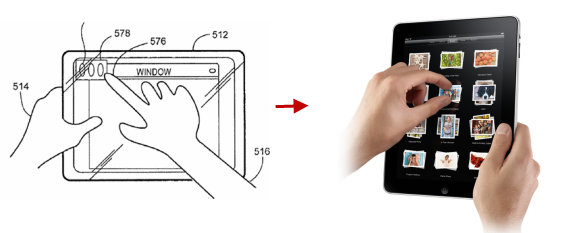
Rumor: Apple tablet would be a touch-screen tablet.
Reality: Apple’s iPad ended up looking a whole lot like what we saw in the patent applications.
Rumor: The tablet OS would be based on the iPhone OS.
Reality: Very real. The iPad shares the iPhone’s software development kit, or SDK, and can even run the same applications. It simply scales apps that have been designed for the smaller screen up to its 1024×768-pixel resolution. Though McGraw-Hill CEO flashed about OS info before the event, it was a rumor that the tablet OS would be exactly like iPhone OS.
Rumor: The tablet would be called the iSlate.
Reality: False. Apple seems to have just been covering its bases with the iSlate trademark application and domain grab. This is kind of like buying alternate top-level domains when starting a Web site. That said, Apple could bring this name to a future product–be it hardware or software.
Rumor: The tablet would be called the iPad.
Reality: Despite initial observations that Apple could be in for a legal battle, due to Fujitsu owning the iPad trademark, that’s what Apple ended up going with. This could end up being problematic. Bloomberg reports that Apple’s decision to go ahead with the iPad name, despite Fujitsu’s trademark ownership, could lead to big legal battle. It could also have a similar outcome to the iPhone trademark battle it had with Cisco Systems.
Rumor: The tablet would include textbooks.
Reality: Real, but almost entirely skipped over in Apple’s big unveiling. Part of the reason for that could have been the big slip by McGraw-Hill Chairman and CEO Terry McGraw, who the night before had told CNBC that 95 percent of his company’s content was ready to go for the Apple tablet.
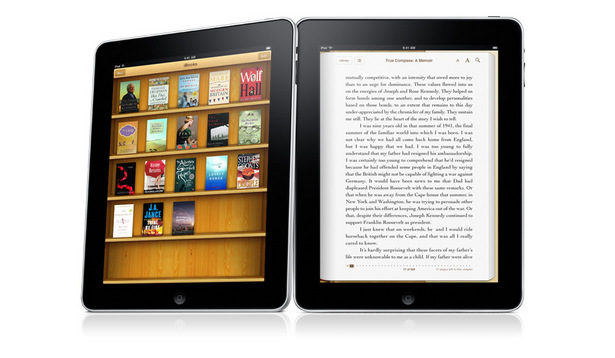
Rumor: Apple was gunning to get book prices between $12.99 and $14.99.
Reality: True. Book prices on the iBooks store fall well within that range, including new releases. It remains to be seen how competitive Apple’s offering is with those of Amazon, Barnes & Noble, and others.
Rumor: The tablet would be powered with a chip from Apple’s in-house manufacturing facilities instead of Intel.
Reality: Very true. The iPad packs a 1GHz chip called the A4 that is Apple-branded. Steve Jobs said it has the processor, graphics processing unit, and input/output memory controller on one chip.
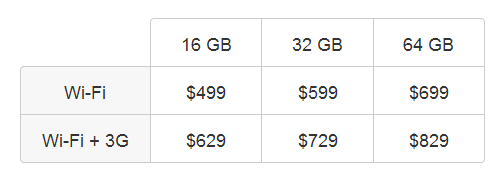
Rumor: The price tag would range between $500 and $2,000, with most guessing less than $1,000.
Reality: Two models in three capacities at six different prices. The pricing, however, came right into line with our expectations, which had been somewhere between $500 and $1,000. Again, this tended to make a lot of sense, considering Apple’s big gap in its portable line between the iPod Touch and its entry-level MacBooks.
Rumor: The ship date. This one was all over the place, from being available the day of the announcement to the nebulous “first half of 2010.”
Reality: Sixty days until the Wi-Fi version is available, and 90 days for the spiffier Wi-Fi-and-3G version. A Wall Street Journal report in December was spot-on.
Rumor: Apple would be making use of multi-touch technology similar to what’s found in its Magic Mouse product to let users interact with the back of the tablet, something that would keep your precious screen free of finger grease when watching movies and browsing the Web.
Reality: False. The back of the iPad is made out of cold, hard, aluminum that has no multitouch capabilities. That’s not to say that Apple hasn’t been planning to add such features to its other products. Patent filings from 2007 suggested the same type of functionality for the iPod Nano.
Rumor: This mock-up was pegged by AppleInsider’s sources as being “strikingly close” to what Apple was working on.
Reality: Despite the mock-up depicting a full version of Apple’s OS X, a sleep button toggle, and a much thinner bezel, this mock-up is pretty accurate.
Rumor: Apple’s tablet would sport a 10-inch OLED screen.
Reality: This, unfortunately, turned out to be false. Although a Digitimes report from November said OLED screens had given Apple a whole heap of trouble during development.
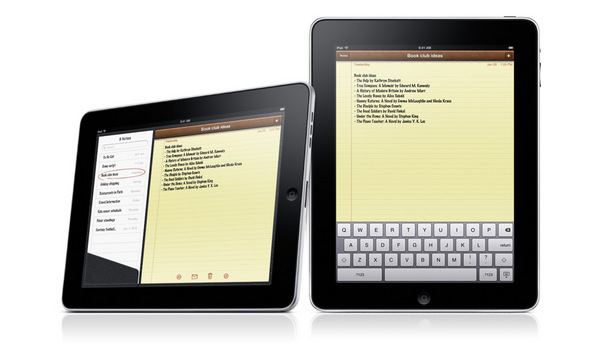
Rumor: Apple was working on a touch-screen-friendly version of iWork.
Reality: This one turned out to be true. And a “version” it is, as it doesn’t actually replace the desktop iteration of iWork. Instead, Apple split iWork into three separate apps, letting users buy each one for $10 a pop.
Rumor: Apple had worked with select developers ahead of launch to get their apps ready for something with a bigger resolution.
Reality: True. We saw demos from Gameloft, The New York Times, Brushes, and Major League Baseball–all of which had apps optimized to fit the larger-resolution screen.
Rumor: The tablet would feature not one, but two cameras, one on the front and one on the back.
Reality: Just like its country cousin the iPod Touch, the iPad is camera-free. That doesn’t mean a camera won’t make it into a future hardware revision.
Rumor: AT&T would be losing its iPhone exclusivity (HotHardware).
Reality: Not yet. If anything, AT&T got more love from Apple by being the only 3G connectivity provider available out of the box for the iPad–that is, until June, when Apple unveils its international plans.
Anything missed? Just leave comments….
Soure: Cnet.com




The iSlate will be iPad’s big brother with OSX and OLED screen. It will be marketed as a laptop replacement.
Thanks for the post. I just installed this for my ipad but haven’t really taken the time to delve into the details.
iPad spy software
Using ipad is many times a technical issues.
How good iPad is for reading e-books since it has back light? What is the readability versus regular e-book readers?
Pingback: My Custom Ipads
Pingback: Ipads Everywhere | Bling for your Ipad