
3D technology is all the rage these days. After the tremendous success of the film Avatar, nobody questions the idea anymore that 3D is the future of entertainment. During the US election, CNN did a gimmick with holographic reporters doing interviews. Though it may have been funny, its all a part of the current fascination with 3D technology.

The people at Gizmodo have come up with a nice and easy to understand explanation for all the technologically-challenged who still don’t understand how 3D works, and a guide to current technologies on the market.
Most 3D operates on a single basic principle—tricking our dumb, binocular brain into interpreting a 2D image into one with depth. The most basic way to do this is stereoscopy, which is essentially showing a slightly different image to each eye which the brain mashes together into a 3D image. We’ve broken up the million different ways to do 3D in a few broad categories.
Stupid Glasses
It’s easiest to do stereoscopic images with glasses or other nerdtastic eyewear to change how you see stuff—hence there are a lot of variations in 3D glasses tech.
 • An anaglyph image is the old school 3D we all know and got headaches from: An image has two different color layers, one for each eye, with slightly different perspectives and when we look at them through those awesome plastic glasses (usually with red and blue lenses) that block one layer in each eye, our dumb brain takes the resulting separate image from each eye and mashes them together to make a 3D scene in our head.
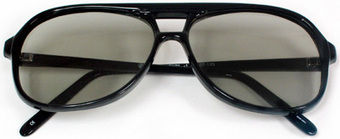 • Polarized 3D glasses are the more modern choice for cheap 3D for the masses—you’ve worn them at IMAX if you’ve caught a 3D movie there, or at Disney World, since the big thing they allow over an anaglyph is full color. They work kind of the same way as the red/blue glasses though—two synced projectors throw images with slightly different perspectives up simultaneously, but at different polarizations. The polarized glasses only allow a single corresponding polarized image into each eye, and the brain does the hard work again, combining two separate images into a single 3D one.
 •The Pulfrich effect is a brain bug where side-to-side motion is interpreted to have some depth when there’s a slight sync lag between your eyes. A set of glasses with a dark lens over one eye will make this happen, so when something moves from left to right, it’ll look like it’s moving back or forward—you know, in 3D. It’s been used for the Super Bowl and Married with Children, since the glasses are so cheap. [Thanks David!]
•ChromaDepth is perhaps the fanciest glasses tech using micro-prisms and whatnot (hello red and blue again), but all it essentially does is slightly shift the way colors are perceived in each eye, so they see different things and boom, 3D. The major limitation of the tech is that if you change the color of an object, you also change how its depth is perceived, since it’s all based on color. (Check out the video above, done in ChromaDepth, to see what I mean.) [Thanks David!]
 • LCD shutter glasses are excellent because they’re so ridiculous. They actually block vision alternately in each eye in time with the refresh rate on the display by rapidly darkening each lens, while the display alternately shows images with a slightly different perspective (this is called alternate frame sequencing). It’s essentially the “show different stuff to each eye” principle taken to its logically absurd conclusion—literally blocking the sight of the unwanted eye. Yes, these complicated puppies usually run over $100 (or way more, even), and can give you a headache on a monitor without a high enough refresh rate.
No Glasses Required
Okay, so you don’t wanna wear glasses. No problem—you just move the one-image-per-eye dance to the display itself.
 • A parallax barrier is one of the more popular ways for swinging 3D without glasses—you see it in Sharp TVs for instance. It actually works a lot like polarized glasses, it just moves where the obstruction magic happens to the front of the TV. Instead of having glasses filter the image for each eye, the screen’s parallax barrier—think of it is a very finely grated fence with precisely angled holes—directs different light into each eye, and your brain turns the mixed signals into a 3D image. The bad part? With a normal parallax barrier, the screen is permanently in 3D mode and you don’t have exactly have a wide viewing angle. Sharp’s trick for 3D in LCD displays is fancier—there’s a second LCD that creates the parallax barrier with a polarized grid of lines, which is nice because you can turn it off and go back to regular 3D viewing.
 • Integral Imaging is a form of parallax actually. You’ve got a bunch of supertiny micro-images that you actually peep through an array of spherical convex lenses, one per micro-image. All these micro-images come together when you look at them to form a 3D image.
• Another form of parallax is continuous-motion parallax. Here, HoloVizio’s system dumps pixels in favor of voxels, which can project multiple light beams in multiple directions simultaneously.
3D in 3D
So far, we’ve just talked about 2D images on a flat screen, which your brain is fooled into thinking are three-dimensional. The other side is creating images in real 3D— you know, meatspace. Still, most of them make use of lighting and projection tricks too.
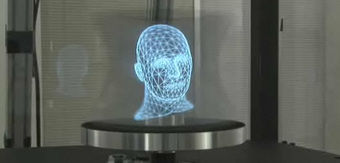 • The Graphics Lab at the University of Southern California has come up with a cheap way to create images in 3D space (as opposed to planar space) by using a spinning mirror called a light-field display. Basically high speed video is projected onto a quickly spinning mirror, which then “reflects a different and accurate image to each potential viewer.” The system uses an algorithm to figure out the correct shading and occlusion for the image.
 • Japanese researchers’ new plasma-laser hologrammy device takes advantage of the “plasma emission phenomenon near the focal point of focused laser light.” By manipulating the laser’s focal point, along the x, y and z axes, they can display real 3D images in mid-air.
• Heliodisplay actually creates a surface in mid-air to project an image onto, which allows you to do the “Help me Obi-wan Kenobi” type of floating holograms that look 3Dish, though they’re actually planar (2D) images. Yep, it’s expensive.
FAKE FAKE FAKE
There are lots of suggested 3D images out there that aren’t any kind of real 3D—videogames are of course the most obvious. But why pick on them when you can pick on CNN?
• Sorry Wolf, but we gotta hit people with the truth: CNN’s “holograms” are totally fake. We already explained this before, but no one was projected in front of Wolf Blitzer. He was looking at a wall. What we saw at home as computer-generated: A bunch of HD cameras filmed the hologramee from all sides, computers crunched that data and delivered whatever angle the studio camera needed at the time. As long as the source angle was synced to the studio angle, it looked, to viewers at least, like a 3D “hologram.” Nice try, Wolfie. Call us when you score an R2 unit.
Source: Gizmodo.
